Quick Answer
For a young Bichon Frise puppy, the most important considerations are a complete and balanced food appropriate for growth, clear feeding directions, appropriate calorie intake, and a consistent feeding routine. Puppies do not necessarily need a food marketed as a ��special puppy�� formula if the product is appropriately labeled for their life stage. ZEAL foods that carry the AAFCO All Life Stages positioning can be considered within an age-appropriate feeding routine, while the exact amount should be based on the product's feeding directions and the puppy's individual needs. For very young puppies, including searches such as dog food for 1 month old puppy, feeding needs can differ considerably from those of a two-month-old puppy. Puppies that are unusually young, newly weaned, or experiencing health concerns should be guided by a veterinarian rather than choosing food based on age or breed alone.
What Should You Look for in Food for a Bichon Frise Puppy?
Choosing food for a young puppy is less about finding a product with the word ��puppy�� on the front and more about understanding nutritional adequacy, life stage, feeding directions, and the puppy's individual needs.
This matters for Bichon Frise puppies just as it does for other young dogs. A Bichon Frise may be small in size, but a growing puppy still needs a nutritionally complete diet that supports the demands of growth.
When comparing puppy foods, start with the nutritional adequacy statement. AAFCO recognizes growth and ��all life stages�� as appropriate life-stage categories, and its guidance emphasizes matching food to the animal's species and life stage. Feeding directions should also be followed as a starting point and adjusted when appropriate for the individual puppy.
Does a 2-Month-Old Puppy Need Special Puppy Dog Food?
A two-month-old puppy is in an active period of growth, so the nutritional adequacy statement on the food matters more than marketing language such as ��special puppy dog food.��
Some foods are labeled for a limited life stage, while others are labeled for all life stages. An appropriately labeled All Life Stages food can provide a nutritional option for puppies when fed according to its directions.
AAFCO notes that foods labeled for all life stages should provide different feeding directions for growth, maintenance, and gestation or lactation. That distinction is important because the same food may be used differently depending on the animal's life stage.
In other words, the word ��puppy�� on a package is not by itself what makes a food appropriate. Look at the nutritional adequacy statement, feeding directions, calorie information, and ingredient information together.
What About the Food for a 2 Month Old Puppy?
People searching for the food for 2 month old puppy are usually trying to answer a practical question: what should a very young dog eat every day?
There is no single food that is automatically the right choice for every puppy. A useful starting point is to choose a complete and balanced food that is appropriate for the puppy's life stage, then follow the feeding directions on the label.
AAFCO explains that puppies have different nutritional requirements from mature dogs because growth requires different nutrient quantities and ratios. Calorie needs can also vary with age, body size, activity, and other individual factors.
For a Bichon Frise puppy, a consistent feeding schedule and careful observation of body condition can therefore be more useful than choosing a food simply because it is marketed as premium, specialty, or breed-specific.
What About Dog Food for a 1 Month Old Puppy?
The search for dog food for 1 month old puppy deserves a little more caution because a one-month-old puppy is much younger than a typical recently weaned puppy.
At this age, feeding should not be approached in the same way as feeding an older puppy. Weaning status, previous nutrition, body condition, and individual development all matter.
If a puppy is only around one month old, particularly if it has not completed the transition to solid food, a veterinarian can provide guidance on the appropriate feeding process and schedule. The goal should be a nutritionally adequate transition rather than simply selecting a dry or wet food based on a package claim.
For older puppies that are already eating solid food, the same basic principles apply: check the nutritional adequacy statement, use the feeding directions as a starting point, and monitor the puppy's growth and body condition.
How Should You Choose Food for a Small-Breed Puppy?
Bichon Frise puppies are small dogs, so portions can be relatively small while still providing a meaningful amount of daily nutrition. That makes accurate feeding particularly useful.
Instead of relying on a fixed portion for every puppy, consider the product's calorie content and feeding directions alongside the puppy's current weight, growth stage, activity, and individual condition.
AAFCO also notes that feeding directions are guidelines rather than an inflexible prescription. If a puppy is gaining or losing weight, the amount of food may need to be adjusted.
A simple routine can help:
- Measure meals consistently.
- Follow the feeding directions for the puppy's life stage.
- Keep fresh drinking water available.
- Monitor body condition and growth over time.
- Make food changes gradually rather than switching repeatedly.
What Makes ZEAL an Option for a Growing Puppy?
ZEAL approaches pet nutrition around reliable ingredients, traceability, and responsible sourcing. The brand was founded in New Zealand in 1999 and offers wet food made in New Zealand alongside air-dried food made in Canada.
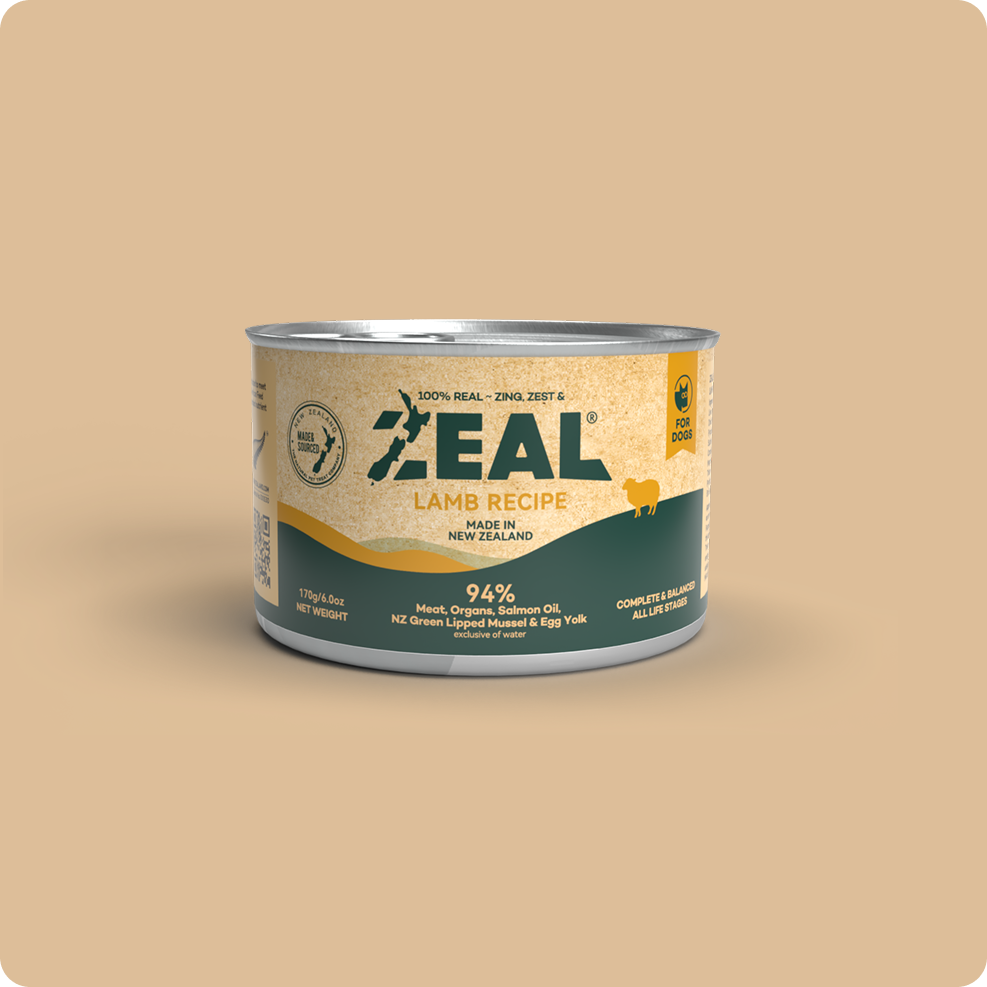
ZEAL's dog wet food is made with 94% real meat and organs, green-lipped mussels, egg yolk and salmon oil. The wet food range is grain-free, contains no added sugars, and is positioned as AAFCO Complete & Balanced.
ZEAL's dog air-dried recipes take a different approach, with 96% real meat & organs and the food gently air-dried in Canada. The recipes are grain-free and contain no added sugars, with organic fruits and vegetables and selected superfoods included according to the individual recipe.
Wet food and air-dried food are different product categories with different production methods and ingredient profiles, so it helps to compare them on their own terms.
ZEAL Wet Food vs. Air-Dried Food for Puppy Feeding
| Consideration | ZEAL Wet Food | ZEAL Air-Dried Food |
|---|---|---|
| Production | Made in New Zealand | Gently air-dried in Canada |
| Meat and organ content | 94% real meat and organs, green-lipped mussels, egg yolk and salmon oil | 96% real meat & organs |
| Format | Moist food | Air-dried food |
| Feeding use | Daily meal option | Daily feeding, topper, or convenient feeding option according to the product directions |
Both can fit into different feeding routines, but the decision should begin with the individual product's nutritional adequacy statement and feeding directions rather than assuming that one format is automatically more appropriate for every puppy.
What About Food for a Micro Bully Puppy?
The search term food for micro bully puppy reflects another common question: whether a particular breed or size requires a completely different type of food.
Breed and adult size can be useful context when considering feeding habits, but they should not be used to claim that a particular ZEAL recipe was specifically designed or formulated for that breed.
The same principle applies to Bichon Frise puppies. A breed-specific search can help owners understand general feeding considerations, but the actual food choice should still be based on the puppy's life stage, nutritional adequacy, feeding directions, individual needs, and preferences.
How Ingredients Can Fit Into a Puppy Feeding Routine
Ingredient lists can help owners understand what is actually in a food, but individual ingredients should be considered as part of the complete formulation rather than in isolation.
ZEAL dog air-dried recipes include meat and organs together with ingredients such as pumpkin, bamboo fiber, green-lipped mussel, turmeric, ginger, yucca schidigera, kelp, and organic fruits and vegetables, depending on the recipe.
ZEAL dog wet food recipes use a different ingredient structure, combining real meat and organs with green-lipped mussels, egg yolk, and salmon oil.
For everyday nutrition, the complete formulation matters more than selecting a food based on one ingredient alone.
How Much Should a Young Puppy Eat?
There is no single portion that works for every puppy. Feeding amounts depend on factors such as body weight, age, activity, food calorie density, and individual growth.
Start with the feeding directions supplied with the specific food. For an All Life Stages product, use the directions corresponding to the puppy's growth stage rather than the maintenance amount for an adult dog.
Calorie content is another useful piece of information. AAFCO notes that calorie requirements vary according to factors including age, weight, activity, and individual circumstances, so calorie information should be considered together with feeding directions rather than used as the only measure when selecting a food.
Should You Change a Puppy's Food Frequently?
Young puppies generally benefit from a predictable feeding routine. Frequent changes can make it harder for an owner to understand how much the puppy is eating and how it is responding to a particular food.
When a food change is needed, a gradual transition can be a practical approach. Introduce the new food progressively while monitoring appetite, stool quality, and overall feeding behavior.
If a puppy has a persistent digestive issue, abnormal appetite, poor growth, or another health concern, food selection should not be used as a substitute for veterinary evaluation.
A Practical Puppy Food Checklist
- Check that the food is intended for dogs.
- Check the nutritional adequacy statement.
- Confirm that the life-stage positioning is appropriate for growth.
- Read the feeding directions for the puppy's current stage.
- Consider calorie content and current body condition.
- Review the ingredient list rather than focusing on a single ingredient.
- Choose a feeding format that works for your household and puppy.
- Keep the feeding routine consistent.
Final Thoughts
Choosing food for a young Bichon Frise does not require a complicated formula. Start with nutritional adequacy, life-stage information, feeding directions, ingredient transparency, and a routine that you can follow consistently.
Whether you are researching food for a two-month-old puppy, looking into options for a very young puppy, or comparing food for a small breed such as a Bichon Frise, the same foundation applies: choose an appropriately labeled complete and balanced food and feed it according to the product's directions and the individual puppy's needs.
ZEAL offers wet food made in New Zealand and air-dried food gently air-dried in Canada, with different recipes across the two categories. Exploring those options starts with understanding what your puppy needs today and choosing the format that fits your daily feeding routine.
Begin with ZEAL: Explore the dog wet food and air-dried food ranges to find a recipe and format that fit your puppy's everyday feeding routine.